News AI Infrastructure
Akamai Agent Sandbox and Inference Service Launch for Secure AI Execution
Akamai introduced Akamai Agent Sandbox and Akamai Inference on October 27 to support secure execution and model serving for AI agents on its cloud platform.

Akamai announced the launch of Akamai Agent Sandbox and Akamai Inference on October 27, 2026, in Cambridge, Massachusetts. The two beta offerings extend the company’s cloud platform to handle model serving and isolated code execution for autonomous AI agents.
Akamai Inference Delivers Managed Model Access
Akamai Inference provides OpenAI-compatible APIs for open-weight and custom models without requiring application changes. Users can choose serverless pay-per-use billing or dedicated GPU deployments. The initial catalog contains 12 open-weight models ranging from 8 billion to 2.8 trillion parameters, including NVIDIA Nemotron 3 Ultra, OpenAI gpt-oss-120b, Google Gemma 4, and several embedding models for retrieval-augmented generation.
The service connects directly to Akamai-managed databases and object storage so enterprises can ground responses with internal data. Execution runs across the company’s global network of points of presence, which reduces latency compared with centralized regions. Dedicated GPU capacity includes new NVIDIA Blackwell Ultra clusters with 8-GPU nodes that deliver 288 GB HBM3e memory per GPU and 2.3 TB total per node.
Company executives stated the addition completes a unified stack for building, running, and protecting AI workloads. Customers already hold more than $14 billion in multiyear Akamai Cloud contracts, indicating existing demand for integrated infrastructure and security services.
Agent Sandbox Applies WebAssembly Isolation
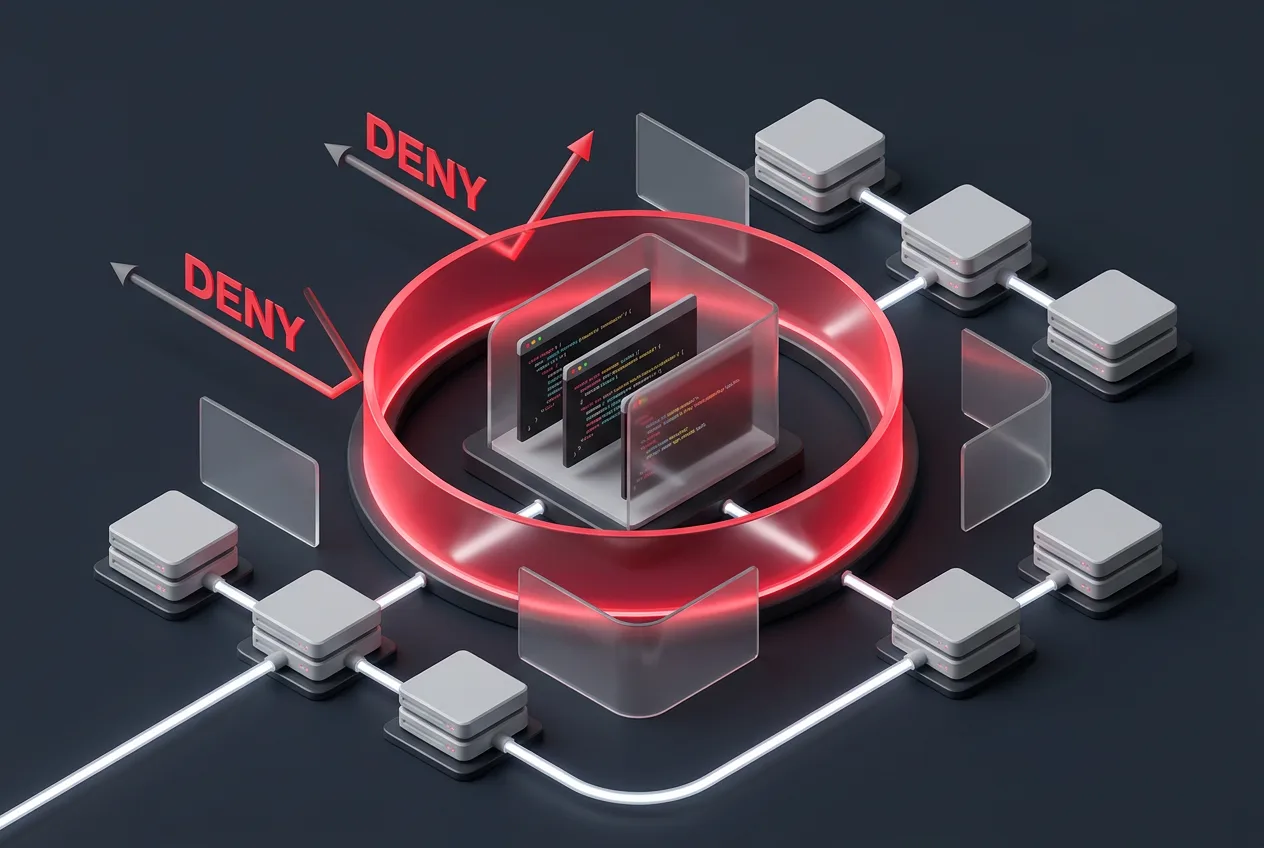
Akamai Agent Sandbox executes AI-generated JavaScript or Python code inside a nested environment built on Akamai Functions and the open-source Spin framework. WebAssembly isolation enforces deny-by-default outbound access and applies strict limits on compute, memory, system calls, and network activity. The design prevents agent-written code from affecting other workloads or external systems.
Preview sessions support intermittent execution of roughly one minute per step. Stateful and long-running agents remain on the roadmap. Developers can test locally with the Spin SDK before deploying to Akamai Functions, preserving the same security boundaries in both environments.
The sandbox addresses growing enterprise adoption of agents that generate and run their own code. By combining the execution layer with Akamai’s existing security, networking, and storage services, the platform keeps all components under a single set of controls and contracts.
Availability and Next Steps
Both products entered beta on October 27, 2026. Serverless Inference options are open for immediate use, while access to certain GPU clusters requires direct sales contact. The open-source Spin SDK is already available for local development and testing. Future updates are expected to add governance tools, stateful execution support, and expanded control mechanisms.
Akamai continues to prepare infrastructure for the NVIDIA Vera Rubin platform scheduled for 2027. The current GPU fleet expansion and the new AI services position the company to serve both inference demand and the security requirements that accompany autonomous agents.
Frequently asked questions
What models does Akamai Inference support at launch?
The initial catalog includes 12 open-weight models from 8B to 2.8T parameters along with embedding models for RAG workloads.
How does Akamai Agent Sandbox isolate code?
It uses WebAssembly through the Spin framework with deny-by-default network rules and resource limits that separate agent-generated code from the runtime and other workloads.
When will Akamai Agent Sandbox reach general availability?
The company has not announced a GA date; both services remain in beta with additional governance and stateful execution features planned.
Can developers test Akamai Agent Sandbox locally?
Yes, the open-source Spin SDK allows local development that mirrors the security model used when code later runs on Akamai Functions.
Comments 3