News SpaceX
SpaceX Orbital AI Data Centers Receive FCC Authorization for One Million Satellites
On November 25, 2026, the FCC granted SpaceX conditional approval to deploy up to one million satellites operating as orbital AI data centers in low Earth orbit.

The FCC issued conditional authorization on November 25, 2026, to SpaceX for the Starmind non-geostationary orbit constellation of up to one million satellites that will function as orbital AI data centers. The order, designated DA-26-1273, covers six orbital shells between 500 km and 1,002 km altitude and allows primary use of optical inter-satellite links with radio-frequency backup in the 18.8–19.3 GHz and 28.6–29.1 GHz bands.
Deployment Schedule and Technical Requirements
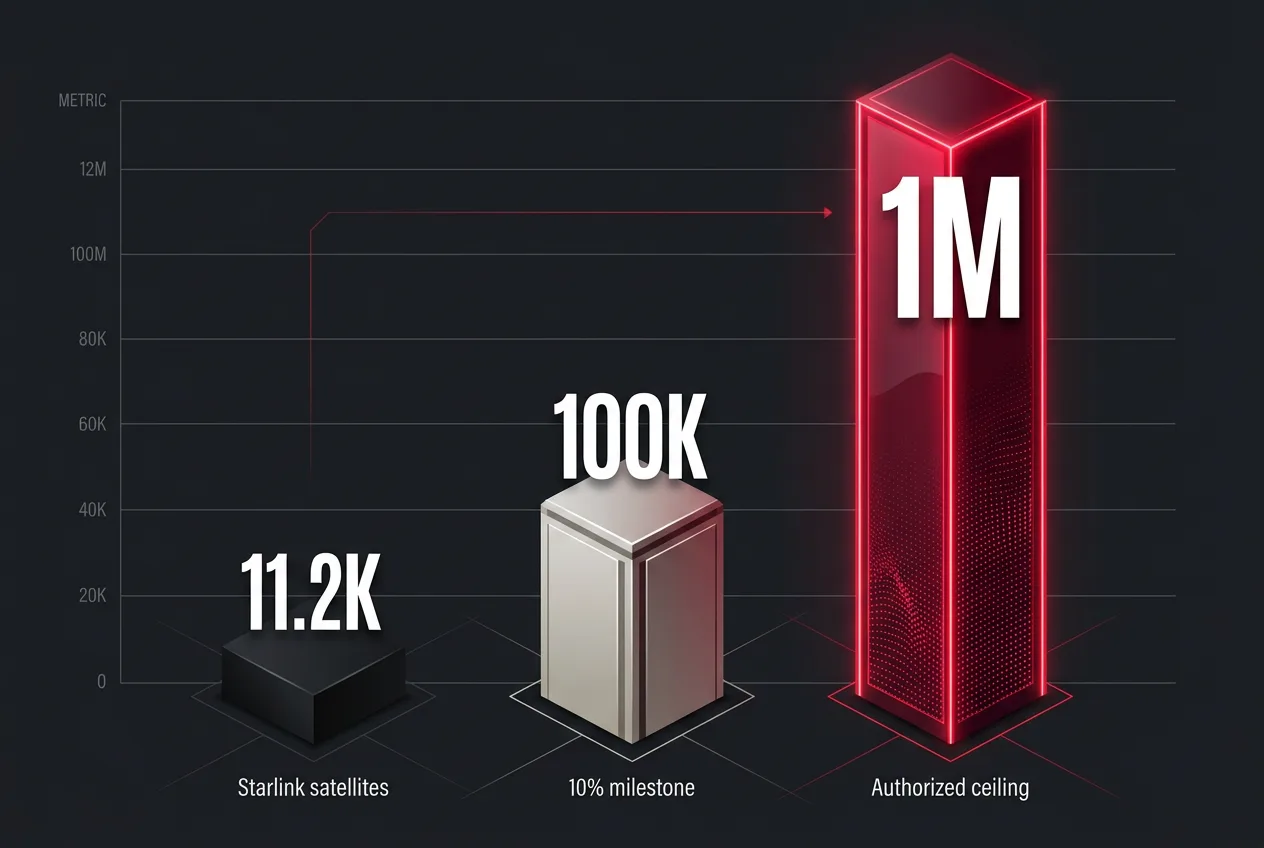
The license sets strict milestones that SpaceX must meet or lose authorization. At least one operational satellite must fly by November 25, 2033. Ten percent of the constellation, or 100,000 satellites, must be active by November 25, 2035. Half the fleet must reach orbit by November 25, 2038, and the full one million satellites must be deployed by November 25, 2040. The FCC deferred certain higher-altitude disposal waivers and required additional debris-mitigation filings before those shells can be used.
SpaceX plans to begin prototype launches of the Starmind satellites as early as the third or fourth quarter of 2027 using Starship vehicles. Volume production is scheduled to accelerate in 2028 and 2029 through a dedicated Gigasat manufacturing facility and collaboration with Nvidia on the onboard compute payloads. The satellites are designed to draw near-constant solar power, which the company states will lower energy costs and reduce terrestrial land and water use compared with ground-based facilities.
The agency rejected petitions to deny filed by Amazon’s Project Kuiper, Viasat, and the American Astronomical Society. Those filings raised concerns about spectrum interference, orbital debris risk, and impacts on ground-based astronomy. The FCC found that the proposed operations, with the imposed conditions, adequately addressed the objections for the lower altitude shells.
Background and Market Context
SpaceX filed the Starmind application in January 2026. At the time of the decision the company already operated roughly 11,200 Starlink satellites, representing the majority of the approximately 17,000 active satellites then in orbit. The new constellation will share optical links with the existing Starlink network for data routing and will rely on the same ground stations for emergency telemetry, tracking, and command.
Chairman Brendan Carr described the authorization as opening infrastructure needed for continued U.S. leadership in AI. SpaceX stated that the orbital placement allows continuous solar exposure and avoids many constraints that limit expansion of terrestrial data centers. The FCC is currently reviewing additional proposals for orbital data centers from other applicants, indicating that further decisions on the category are expected in coming months.
Industry analysts note that the milestone schedule aligns with Starship’s projected flight cadence and with Nvidia’s roadmap for compact, radiation-tolerant AI accelerators. Meeting the 2035 and 2038 targets will require sustained launch rates far above current levels, a capability SpaceX has tied to the operational debut of its next-generation vehicle and factory output goals.
Frequently asked questions
What milestones must SpaceX meet for the Starmind constellation?
SpaceX must place at least one satellite by November 25, 2033, 100,000 satellites by 2035, 500,000 by 2038, and the full one million by 2040 or risk license revocation.
Which frequency bands are authorized for the orbital AI satellites?
Primary communications use optical inter-satellite links. Radio-frequency backup is permitted in the 18.8–19.3 GHz downlink and 28.6–29.1 GHz uplink bands for telemetry, tracking, and command.
Did the FCC address concerns from other companies and astronomers?
The FCC rejected petitions from Amazon Kuiper, Viasat, and the American Astronomical Society after determining that imposed conditions on debris mitigation and spectrum use sufficiently addressed interference and orbital safety issues.
When does SpaceX expect to launch the first Starmind prototypes?
SpaceX targets prototype launches in the third or fourth quarter of 2027 aboard Starship, with volume production planned for 2028–2029 through a new Gigasat factory.
Comments
No comments yet. Be the first!