News Monero
Monero FCMP++ Upgrade Clears zkSecurity Audit With No High-Severity Findings
zkSecurity completed an audit of Monero’s generalized-bulletproofs crate with no high- or medium-severity findings, advancing the FCMP++ privacy upgrade.
On November 12, 2026, MAGIC Grants announced that zkSecurity had finished an audit of the generalized-bulletproofs crate in the monero-oxide Rust project. The review covered commit f3660043e042b5608fc9c8ce1383cee238da9d0a, a core element of the planned Monero FCMP++ privacy upgrade. Researchers Mathias Hall-Andersen and Suneal Gong performed the work under a contract signed in June 2026.
Monero FCMP++ Audit Results and Formal Verification
The audit ran for ten working days and identified four low-severity issues plus three informational findings. Monero-oxide developers have already addressed all reported items. No high-severity or medium-severity vulnerabilities were discovered. zkSecurity also published a machine-checked formal proof in the Lean theorem prover that confirms the Generalized Bulletproofs protocol meets completeness, zero-knowledge, and knowledge-soundness properties for the interactive version in an abstract group.
The Lean proof does not extend to the non-interactive Fiat-Shamir variant used in Monero, the concrete Rust code, the specific curves chosen for FCMP++, or higher-level circuits. Those elements remain covered by the written audit, prior code reviews, and earlier independent assessments from Trail of Bits and Veridise. The formal verification serves as an additional layer of assurance for the cryptographic primitives themselves.
Monero’s official channels acknowledged the audit outcome on November 18, 2026. The results align with the project’s practice of publishing multiple independent reviews before any hard-fork activation.
Context for FCMP++ and Remaining Development Steps
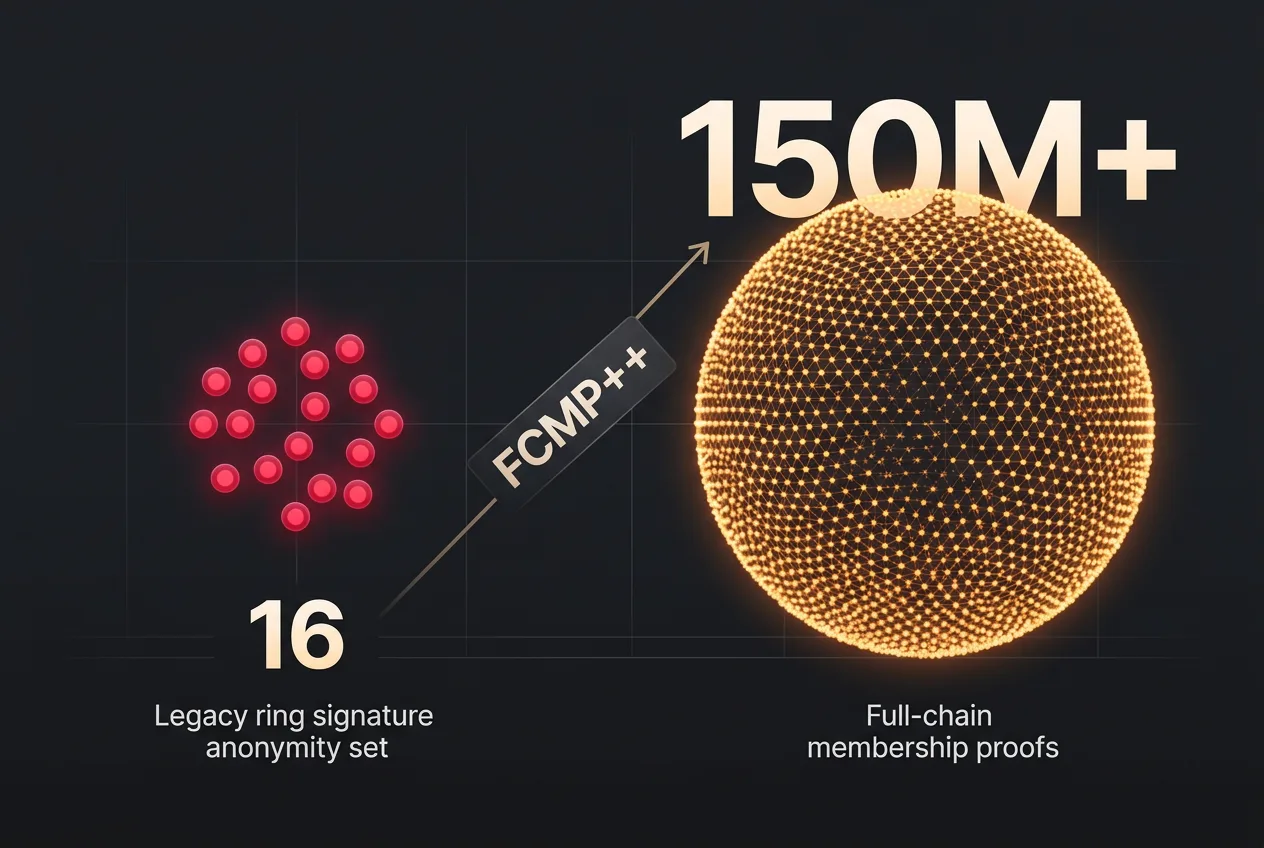
FCMP++ replaces Monero’s current ring signatures, which use a ring size of 16, with full-chain membership proofs. Each input would draw from the full historical set of outputs, estimated at more than 150 million outputs. The upgrade is developed in parallel with the Carrot addressing scheme and requires a future network hard fork. A public beta stressnet has been active, with the most recent fork occurring on October 5, 2026, at block 3,102,800.
Additional integration audits are funded through the Community Crowdfunding System. Wallet and hardware wallet teams continue implementation work. No mainnet hard-fork height or activation date has been set as of November 19, 2026. Project contributors have stated that activation will follow only after all readiness criteria, including further testing and review, are satisfied.
Impact on Monero Privacy Model
The clearance of the zkSecurity review removes one technical checkpoint for the Monero FCMP++ upgrade. Expanded anonymity sets address long-standing discussions about ring-signature scalability. Continued stressnet testing and subsequent audits will determine the final timeline. Users and node operators should monitor official Monero communication channels for updates on testing milestones and eventual fork coordination.
Frequently asked questions
What did the zkSecurity audit cover for Monero FCMP++?
The audit examined the generalized-bulletproofs crate at a specific commit in the monero-oxide project. It reviewed the protocol implementation over ten working days and produced a formal Lean proof for the interactive version.
Were any critical issues found in the Monero FCMP++ audit?
No high-severity or medium-severity issues were identified. The audit listed four low-severity issues and three informational findings that developers have addressed.
Does the Lean proof cover the full Monero implementation?
The formal proof covers the interactive protocol in an abstract group. It does not include the non-interactive Fiat-Shamir transform, the Rust code, FCMP++ curves, or application circuits.
When will Monero activate the FCMP++ hard fork?
No activation date or block height has been announced. Further stressnet testing, additional audits, and wallet integration must complete before any fork is scheduled.
Comments 1