News Blockchain
Espresso Mainnet Finalty Reaches 400 Milliseconds After Two Years of Upgrades
Espresso mainnet finalty reached approximately 400 milliseconds in November 2026 after two years of operation and targeted upgrades to consensus and networking.

Espresso mainnet finalty reached approximately 400 milliseconds on the live network in November 2026. The achievement comes two years after mainnet 0 launched in November 2024 and follows a series of upgrades completed earlier this year.
The network now sustains 181 MB/s data throughput while delivering deterministic BFT finality. This performance supports an estimated one million simple token transfers per second under the stated assumptions.
Espresso Mainnet Finalty Benchmarks and Throughput Results
Tests conducted on 100 validators with emulated global latency showed median finality of 334 milliseconds under light load. The 95th percentile reached 353 milliseconds and the maximum stayed below 387 milliseconds. At peak load with 70 MB blocks the median finality rose to 778 milliseconds while the network maintained the full 181 MB/s throughput.
Production measurements on the live mainnet report consistent finality around 400 milliseconds, or roughly one third of a second. Throughput has grown from the initial 30 MB/s at launch to the current 181 MB/s level. The capacity figure assumes 180-byte transfers and reflects theoretical maximums derived from block production rates.
Over the two-year period the network has produced 31.7 million blocks. Validators include institutional operators such as Blockdaemon and Kraken. Finality remains irreversible provided fewer than one third of stake is faulty, consistent with the BFT guarantees of the HotShot protocol.
Technical Changes That Delivered Subsecond Finality
The September 2026 subsecond finality upgrade introduced single-view consensus, reducing message hops from seven or more to three. Networking switched to the Cliquenet mesh topology for one-hop propagation. Block building moved in-node and erasure coding was accelerated with combined XOR and Reed-Solomon techniques plus BLAKE3 hashing. The DA committee round was removed, cutting per-block work by approximately two thirds.
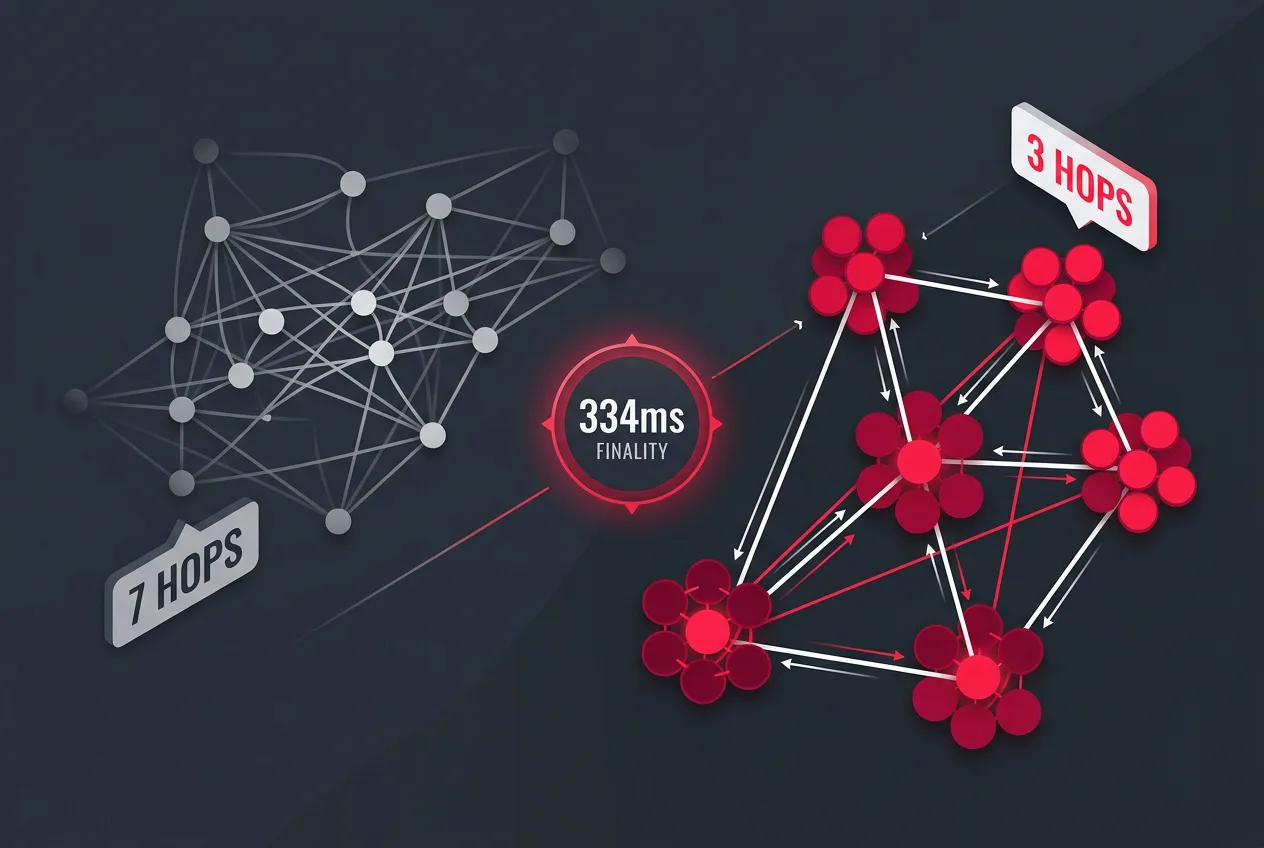
An earlier permissionless proof-of-stake transition completed in March 2026 lowered average finality from roughly 10 seconds to 3 seconds. The latest changes then brought finality below one second across measured conditions. The system remains a data-availability and consensus base layer without its own virtual machine; execution occurs on integrated chains.
Integrations already include ApeChain with additional sovereign chains such as Celo in progress. The design targets institutional workloads including tokenized assets and real-time settlement, following earlier discussions with entities focused on those use cases.
Network Evolution and Continued Optimization Plans
Espresso began as a permissioned network with 22 validators and 100 nodes in November 2024. It transitioned to a fully permissionless staking model in early 2026. The current validator set operates under the HotShot BFT protocol with no smart-contract execution on the base layer itself.
Future work centers on heavier transaction types such as AI-agent interactions, post-quantum signatures, and privacy proofs. The team continues to prioritize ecosystem expansion while maintaining the observed performance edge among deployed base layers. No specific milestone dates beyond ongoing optimizations have been announced.
Frequently asked questions
What is the current finality time on Espresso mainnet?
Live measurements show approximately 400 milliseconds median finality under normal conditions. Benchmarks with 100 validators confirm values between 334 and 387 milliseconds at light load.
How much data throughput does Espresso sustain?
The network handles 181 MB/s throughput at peak load. This capacity supports roughly one million simple transfers per second based on 180-byte transaction sizes.
When did the subsecond finality upgrade activate?
The upgrade went live on September 9, 2026. It introduced single-view consensus and reduced message hops from seven or more to three.
Does Espresso run smart contracts or a virtual machine?
No. Espresso functions as a data-availability and consensus base layer only. Execution and smart-contract logic run on integrated chains that use Espresso for settlement.
Comments 1