News AI
Liquid AI LFM3 Family Launches Six Open-Weight 2B Multimodal Models
Liquid AI released the LFM3 family of six open-weight models on October 27, 2026, each built from a shared 1.7B backbone and optimized for local deployment on consumer and edge devices.
Liquid AI released the LFM3 family of six open-weight models on October 27, 2026. The models share a common backbone and target on-device AI workloads across text, vision-language, audio and decision-making tasks.
All six variants derive from the LFM3-1.7B-Base, a 1.73-billion-parameter text model pretrained on 22 trillion tokens. The architecture combines 13 gated short-convolution layers, five sliding-window attention layers with a 256-token window and six global attention layers within 24 blocks, paired with a 128K vocabulary.
LFM3 Model Variants and Technical Specifications
The released collection includes LFM3-1.7B for text with 256K context, LFM3-VL-2B at 1.92 billion parameters for vision-language inputs including video at two frames per second, LFM3-Audio-2B for speech input and output across 18 languages with tool calling, LFM3-Omni-2B at roughly 2.2 billion parameters that combines vision, audio and language with text or speech output, plus two decision models labeled d1-2B and d1-Omni-2B. Each model remains fine-tunable on a single GPU.
Quantized text models occupy approximately one gigabyte at four-bit precision. Supported formats cover GGUF, MLX, ONNX, FP8 and NVFP4. Native runtimes include llama.cpp, MLX, vLLM and SGLang. Hardware compatibility extends to phones such as the Galaxy S26 Ultra, laptops with M4 Max chips, and edge platforms from Qualcomm, AMD, NVIDIA, Arm, Ambarella and Intel. Day-zero partners encompass those chip vendors along with OpenRouter and Vercel.
Performance Results and Market Context
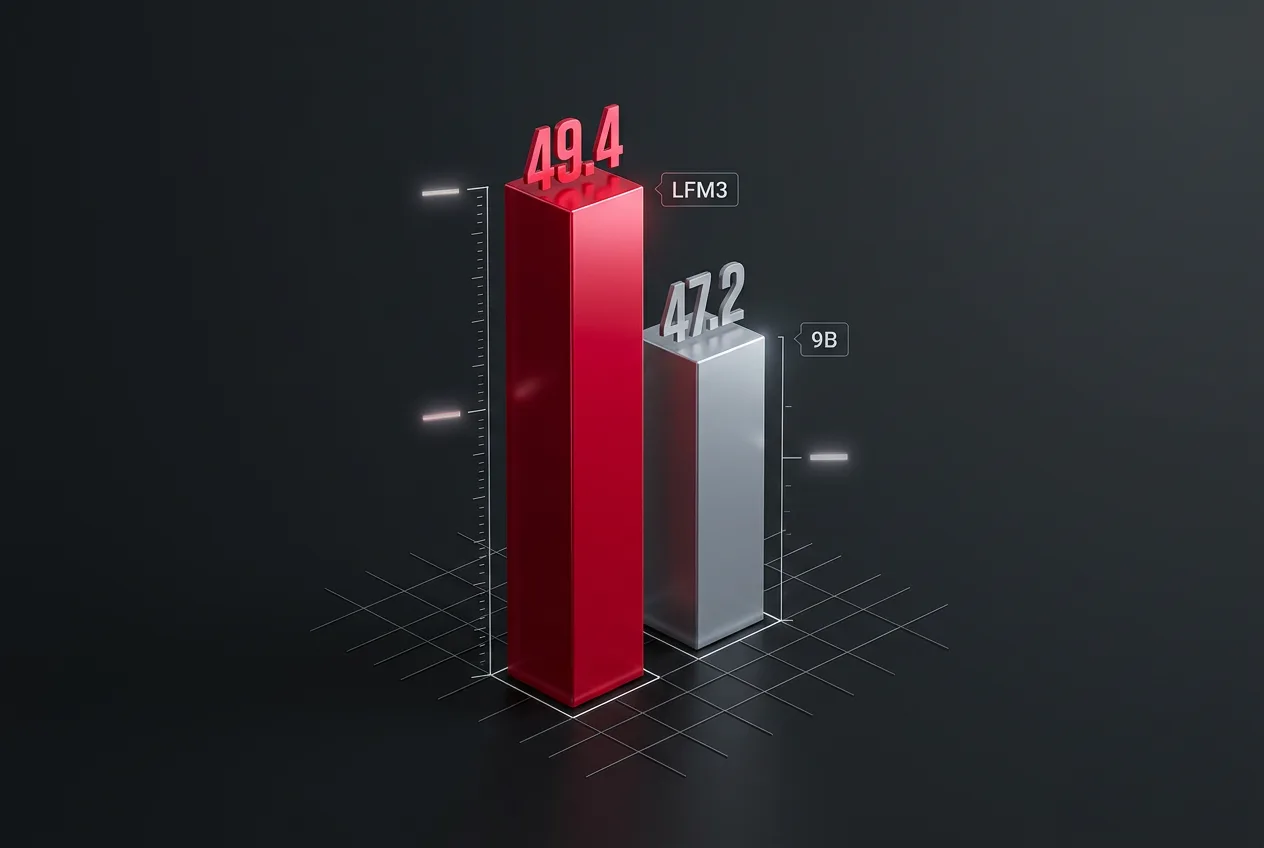
Vendor evaluations place LFM3-1.7B at an average of 49.37 across 29 benchmarks, exceeding Qwen3.5-9B at 47.24 under the same conditions. Notable agentic and tool-use scores include 45.60 on LiveClaw, 71.39 on BFCL V4, 96.66 on IFEval and 38.42 on WebArena-Verified. The vision-language variant LFM3-VL-2B records 71.4 across 62 vision benchmarks, matching results previously reported for Gemma 4 12B.
The release follows Liquid AI’s LFM2 and LFM2.5 models from 2025. Development emphasized architecture search across 14 hardware configurations to favor specialized, on-device intelligence. Pre-release testing involved Mercedes-Benz and Shopify. Weights are available on Hugging Face under the LFM3 collection, with additional access through the Liquid AI Playground and API. The LFM Open License v1.0 permits commercial use at no cost for companies below $10 million in annual revenue.
Deployment Outlook and Next Steps
The models are positioned for immediate local fine-tuning and inference on phones, laptops and edge devices. Liquid AI has not announced subsequent releases or expanded training runs in the launch materials. Developers can download the weights directly and begin integration using the listed inference engines without additional licensing fees for qualifying organizations.
Frequently asked questions
What models are included in the Liquid AI LFM3 family?
The family contains six variants: LFM3-1.7B for text, LFM3-VL-2B for vision-language, LFM3-Audio-2B for speech, LFM3-Omni-2B for combined modalities, and two decision models d1-2B and d1-Omni-2B.
Where can developers download the LFM3 weights?
Weights are hosted on Hugging Face in the LiquidAI LFM3 collection and also accessible through the Liquid AI Playground and API.
What hardware does the LFM3 family support for inference?
Supported platforms include recent Android phones, Apple M4 laptops, and edge chips from Qualcomm, AMD, NVIDIA, Arm, Ambarella and Intel through llama.cpp, MLX, vLLM and SGLang.
What license applies to the LFM3 models?
The LFM Open License v1.0 allows free commercial use for companies with less than $10 million in annual revenue.
Comments 1