News Blockchain
Cronos v1.8 Mainnet Upgrade Delivers Parallel EVM and Over 90 Percent EVM API Equivalence
Cronos EVM mainnet completed its v1.8 upgrade on October 22, 2026, introducing native parallel execution and expanded EVM compatibility on the Cosmos SDK base.
Cronos EVM mainnet v1.8 went live on October 22, 2026, at block height 101,485,000. The upgrade introduced mature parallel EVM execution through native Block-STM and raised EVM API equivalence above 90 percent. Block production and several services experienced roughly 30 minutes of downtime before resuming with unchanged on-chain state.
Technical Changes in the v1.8 Release
The upgrade embeds Block-STM directly in the Cosmos SDK. Non-conflicting transactions now execute in parallel while conflicting ones fall back to sequential processing. An optional application-side mempool allows customized pre-verification and shorter block intervals. More than 80 Ethereum JSON-RPC methods are supported, delivering the stated API equivalence target for wallets, explorers, indexers and developer tooling.
Core dependencies were updated to Cosmos SDK v0.54.3, IBC-Go v11, CometBFT v0.39 and go-ethereum v1.16.9. The go-ethereum update enables the Osaka hardfork on Cronos. RocksDB moved to v10.9.1 with new role-based tuning profiles. Additional work included staking end-block queue optimizations and more than 40 bug fixes covering token mapping, floor-data-gas calculations and EIP-1559 checks.
Breaking changes include restrictions on SendCroToIbc and removal of Interchain Accounts support. Experimental libp2p networking code ships with the release but remains disabled on mainnet. Node operators must run the v1.8.0 binary and review the migration guide for configuration updates such as mempool.type settings.
Performance Impact and Upgrade Context
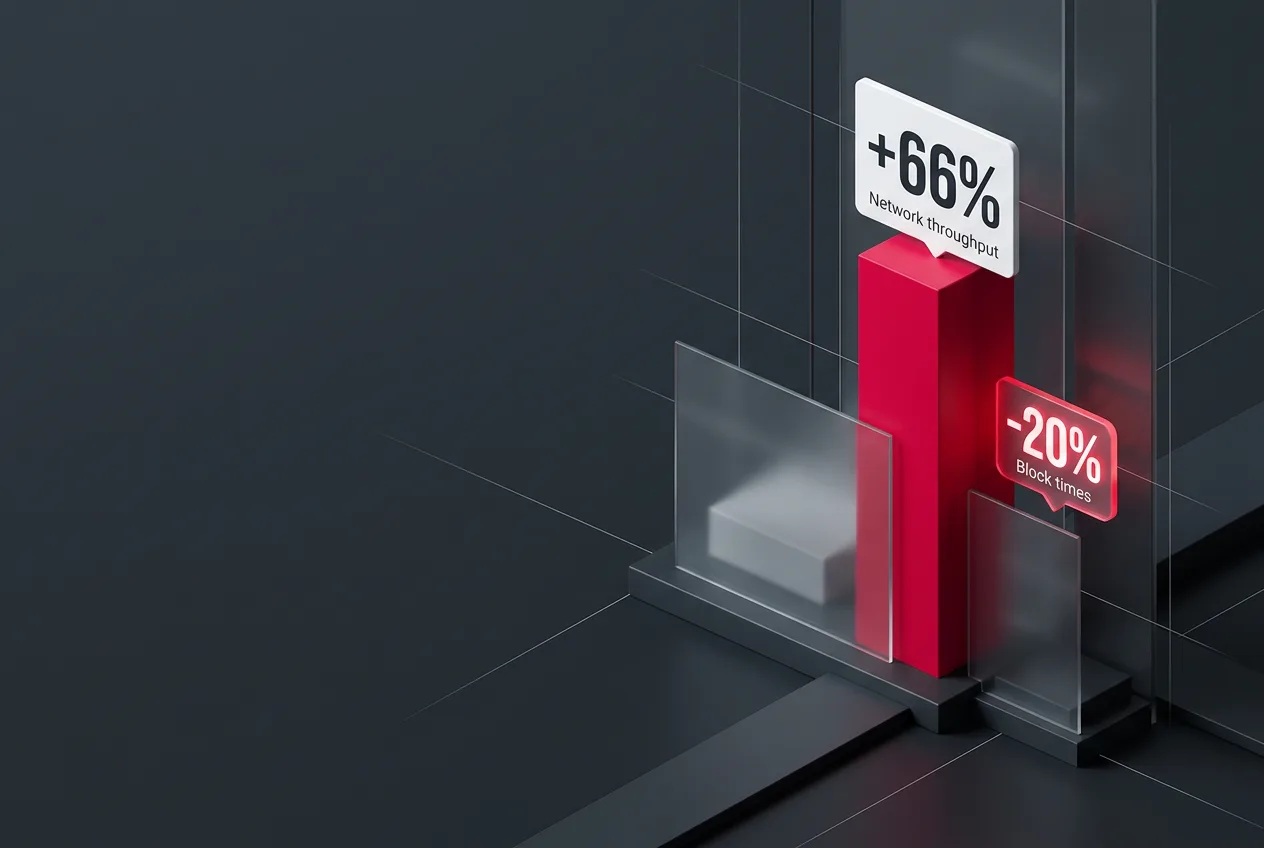
Pre-upgrade simulations showed median block times approximately 20 percent faster and sustained throughput up to 66 percent higher under heavy load. The combination of parallel execution and the application-side mempool is expected to reduce latency and increase capacity, though real-world results depend on transaction mix and node configuration.
This release builds on earlier parallel-execution work that began with Block-STM in the v1.4 Pallene upgrade. The September 30, 2026 testnet run validated the mainnet changes. The project continues to maintain its Cosmos SDK foundation while closing remaining EVM gaps and preparing to activate libp2p networking in a later step.
Next Steps for Operators and Developers
Teams running nodes should complete the binary upgrade and test configuration changes in staging environments. Developers can begin using the expanded JSON-RPC surface immediately, though full parity work continues. The Cronos team has indicated further API coverage and networking improvements will follow in subsequent releases.
Frequently asked questions
When did the Cronos v1.8 mainnet upgrade activate?
The upgrade completed on October 22, 2026, at block height 101,485,000. Block production resumed after approximately 30 minutes of downtime.
What new execution feature does Cronos v1.8 introduce?
Native Block-STM parallel execution is now embedded in the Cosmos SDK. Non-conflicting transactions run concurrently while conflicts revert to sequential processing.
How much EVM compatibility does the upgrade provide?
More than 80 Ethereum JSON-RPC methods are supported, reaching over 90 percent EVM API equivalence for wallets, explorers and indexers.
Which dependencies were updated in Cronos v1.8?
The release includes Cosmos SDK v0.54.3, IBC-Go v11, CometBFT v0.39, go-ethereum v1.16.9 and RocksDB v10.9.1.
Comments
No comments yet. Be the first!